Kilimanjaro in 6 Days: From a Distant Dream to the Roof of Africa
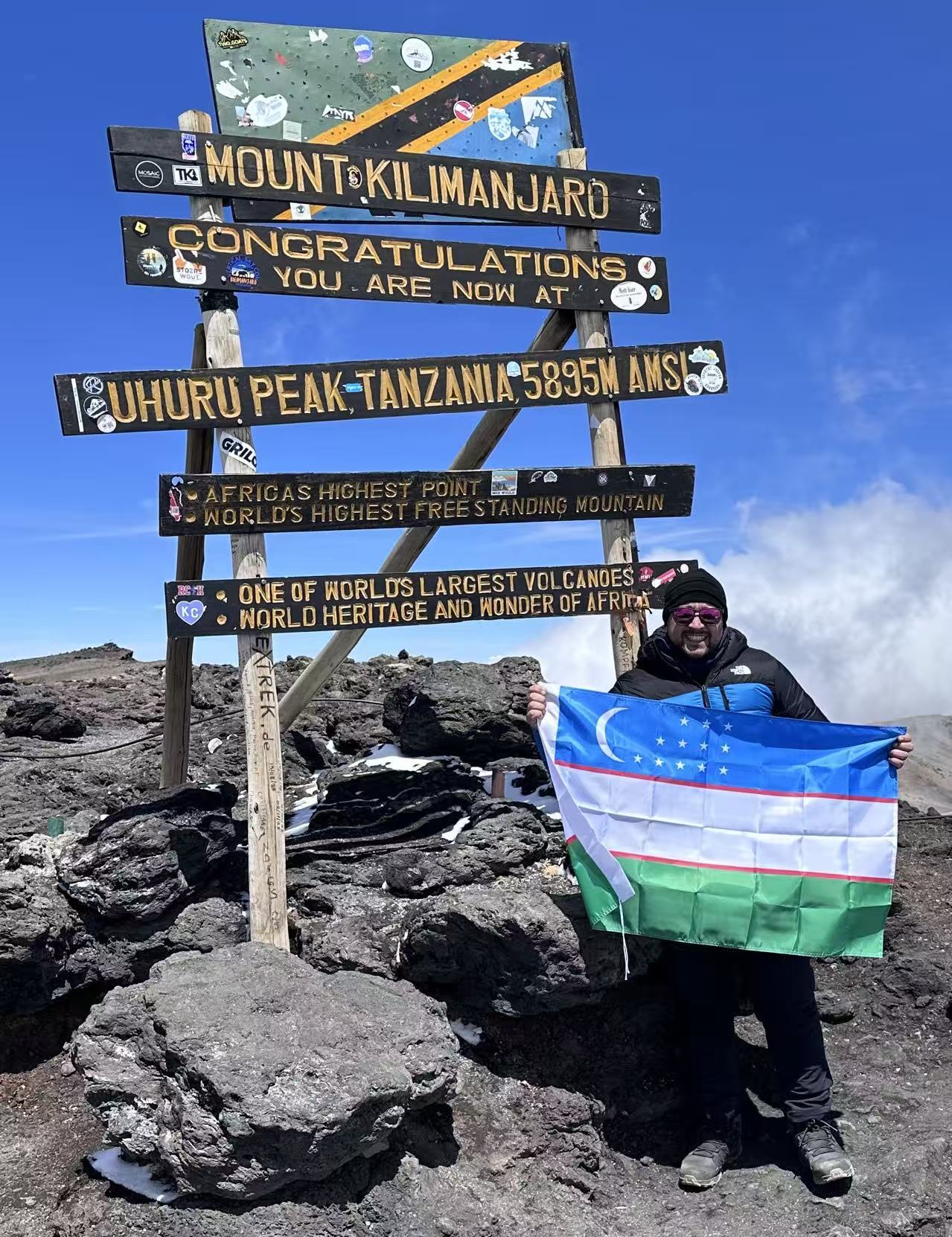
Most operators sell the Lemosho Route as a seven- or eight-day climb, and for good reason: the success rate on eight-day itineraries is around 90%. I compressed it into six — a schedule where roughly 60% of climbers reach the top. On 8 February 2026, at 08:00, I stood on Uhuru Peak with the Uzbekistan flag. This is the honest report of how climbing Kilimanjaro in 6 days actually went: the plan, the numbers, the day-by-day reality, and what I'd tell anyone weighing the same trade.
My name is Jasur Mavlyanov. I'm an entrepreneur based in Hong Kong, originally from Uzbekistan, and Kilimanjaro was the first mountain of my Seven Summits campaign — the highest peak on every continent, something fewer than 500 people in history have completed. It began, as these things do, as a distant dream filed under "one day." This is the story of turning "one day" into day one.
Why Attempt Kilimanjaro in 6 Days?
The honest answer has two parts. The first is logistics: I run several companies across Hong Kong and mainland China, and carving eight or nine days out of the calendar, plus travel to Tanzania, was harder than carving six. The second is temperament. I wanted to know what my body and mind would do when the margin for error was thinner than the brochure version — not reckless-thin, but honest-thin.
Climbing Kilimanjaro in 6 days is not a shortcut; it's a compression. You walk the same trail, gain the same 3,800 vertical metres from the gate, and face the same summit night. What you give up is acclimatisation time — the extra nights your body uses to manufacture red blood cells and adapt to thin air. That is the entire trade, and it's why the success rate falls from roughly 90% on the long itineraries toward 60% on mine.
I made the decision with open eyes, a training plan, and one non-negotiable rule agreed with my guide team before we started: at the first sign of serious altitude sickness, we turn around. The mountain doesn't move. The summit would still be there next year.
The Numbers: What Compression Really Costs
Kilimanjaro is often called a "walkable" mountain because no ropes, crampons or technical climbing are required. That reputation hides the real difficulty: altitude. At 5,895 metres, the summit holds roughly half the oxygen you breathe at sea level. Altitude sickness does not care how fit you are — it cares how fast you ascended.
The industry data is consistent: itineraries of 8 days or more see success rates around 85–95%. Seven days sits near 70–80%. Six days — my plan — is commonly estimated around 60%, with individual operators reporting anywhere from the mid-40s to the mid-60s. And the five-day sprints some agencies still sell? Roughly 30%. Six days felt like the honest edge of the envelope: meaningfully faster than standard, without stepping into coin-flip territory. Still, four in ten people on my schedule go home without the summit, and I treated that number with respect.
The rule was simple: the summit is optional, coming home is mandatory. Any confusion, any stumble that wasn't just fatigue, any headache that painkillers couldn't touch — we descend. No debate at 5,000 metres.
— Field note, written at Barafu Camp
The Route: Lemosho, Compressed
I chose the Lemosho Route — around 70 kilometres from the western rainforest gate to the summit and down the Mweka trail. Lemosho is usually sold as a 7–8 day itinerary precisely because its length gives your body time to adapt. It crosses the Shira Plateau, traverses beneath the Southern Icefields, and launches the summit push from Barafu Camp. It's also, in my opinion, the most beautiful line on the mountain: five climate zones, from jungle to arctic, in a single walk.
Kilimanjaro sits inside Kilimanjaro National Park, and every climber is required to go with a licensed operator and crew. Mine were exceptional — guides who had summited hundreds of times, porters who moved camp faster than I moved myself, and a cook who somehow produced hot soup at 4,600 metres. Whatever you compress, do not compress the quality of your crew. On a six-day plan, they are your safety system.
What Does Kilimanjaro in 6 Days Cost?
Compressing the itinerary saves days, not money — and it shouldn't. A serious operator running Kilimanjaro in 6 days still fields the full crew: licensed guides, porters, a cook, quality tents and safety equipment including oxygen and a pulse oximeter for daily checks. Park fees alone — entry, camping and rescue fees paid to the national park — run to roughly a thousand US dollars per climber before anyone lifts a bag.
Realistic all-in pricing for a well-run private climb sits between $2,500 and $6,000 depending on operator tier, group size and hotel nights in Moshi or Arusha, plus international flights, visas, tips for the crew (budget $250–$350 — they earn every dollar), and gear you don't already own. If a quote comes in dramatically cheaper than the market, that discount is coming out of porter welfare or safety margin, and on a compressed schedule those are exactly the two things you cannot afford to cut. My rule from business applies unchanged on the mountain: never buy the cheapest version of something whose failure mode is catastrophic.
Day by Day on the Mountain
Day 1 — Lemosho Gate to the Rainforest Camp
The trek starts around 2,100 metres in dense montane rainforest — humid, green, loud with colobus monkeys. It's a short first day by design, ending at Mti Mkubwa ("Big Tree") camp near 2,750 metres. The guides set a pace so slow it felt almost comical. Pole, pole, they repeated — Swahili for "slowly, slowly." I would hear those two words a thousand times before the summit, and they became the title of my book.
Day 2 — Onto the Shira Plateau
Out of the forest and into moorland, then the vast, open Shira Plateau at about 3,850 metres. This is where compression starts to bite: on an eight-day itinerary you'd spend an extra night adapting up here. We didn't have one. The headache arrived that evening — mild, manageable, but a message. Hydration, food, and sleep became a job I did with full attention.
Day 3 — Lava Tower and the Barranco Valley
The classic acclimatisation day: climb high to Lava Tower at 4,630 metres, feel terrible, eat lunch, then descend to sleep at Barranco Camp near 3,980 metres. "Climb high, sleep low" is the one adaptation trick a six-day plan fully preserves, and it matters. The evening view of the Barranco Wall — a 250-metre cliff we would climb before breakfast — focused the mind.
Day 4 — The Barranco Wall to Karanga Valley
The Wall turned out to be the most enjoyable section of the whole route: a hands-on scramble, never truly exposed, ending on a ridge with the summit glaciers suddenly close. From there, a rolling traverse into the Karanga Valley and an early arrival at Karanga Camp, 4,035 metres. The short day is deliberate — the last real recovery before the launchpad. I ate everything the cook put in front of me and slept nine hours.
Day 5 — Karanga to Barafu Base Camp
A steep, steady morning to Barafu Camp at 4,673 metres — "barafu" means ice in Swahili, and the wind explains why. We arrived by midday with one job left: rest. Gear laid out, water bottles filled, an early dinner, and horizontal by sunset. The wake-up call was set for 23:00. Nobody really sleeps at Barafu; you just lie still while your heart practices for what's coming.
Night 5→6 — The Summit Push
We stepped out just before midnight into hard cold and a corridor of headlamps zig-zagging up the scree above. The next six hours are why even Kilimanjaro in 6 days remains a serious bet: more than 1,200 vertical metres, in the coldest hours, on almost no sleep, with half the oxygen your body was designed for. My world shrank to a two-metre circle of light and the rhythm of the guide's boots. Step. Breathe. Step. Pole, pole. There is no thinking your way up that slope — there is only continuing.
Day 6 — Uhuru Peak, Then Down to Mweka
Dawn caught us just below the crater rim, turning Mawenzi's jagged silhouette purple and then gold. We reached Stella Point on the rim as the light flooded in, and the final gentle 40 minutes along the crater's edge — past glaciers that look borrowed from another planet — brought us to the sign every climber dreams about. At 08:00 on 8 February 2026, on the morning of the sixth day, I stood at Uhuru Peak, 5,895 metres, the Roof of Africa, holding the flag of Uzbekistan. Then we turned around and descended nearly 2,800 metres to Mweka Camp — the longest single day of my life, and the happiest. Six days to Uhuru: that's where the book got its name.
The Morning After — Out Through the Forest
A final walk down through the rainforest to Mweka Gate: sign the park book, shake every hand on the crew twice, and get handed a cold Kilimanjaro lager that tasted like a trophy. Somewhere on that last descent the mountain stops being a goal and becomes a story — and stories, unlike summits, you get to keep.
Summit Morning: Stella Point to Uhuru Peak
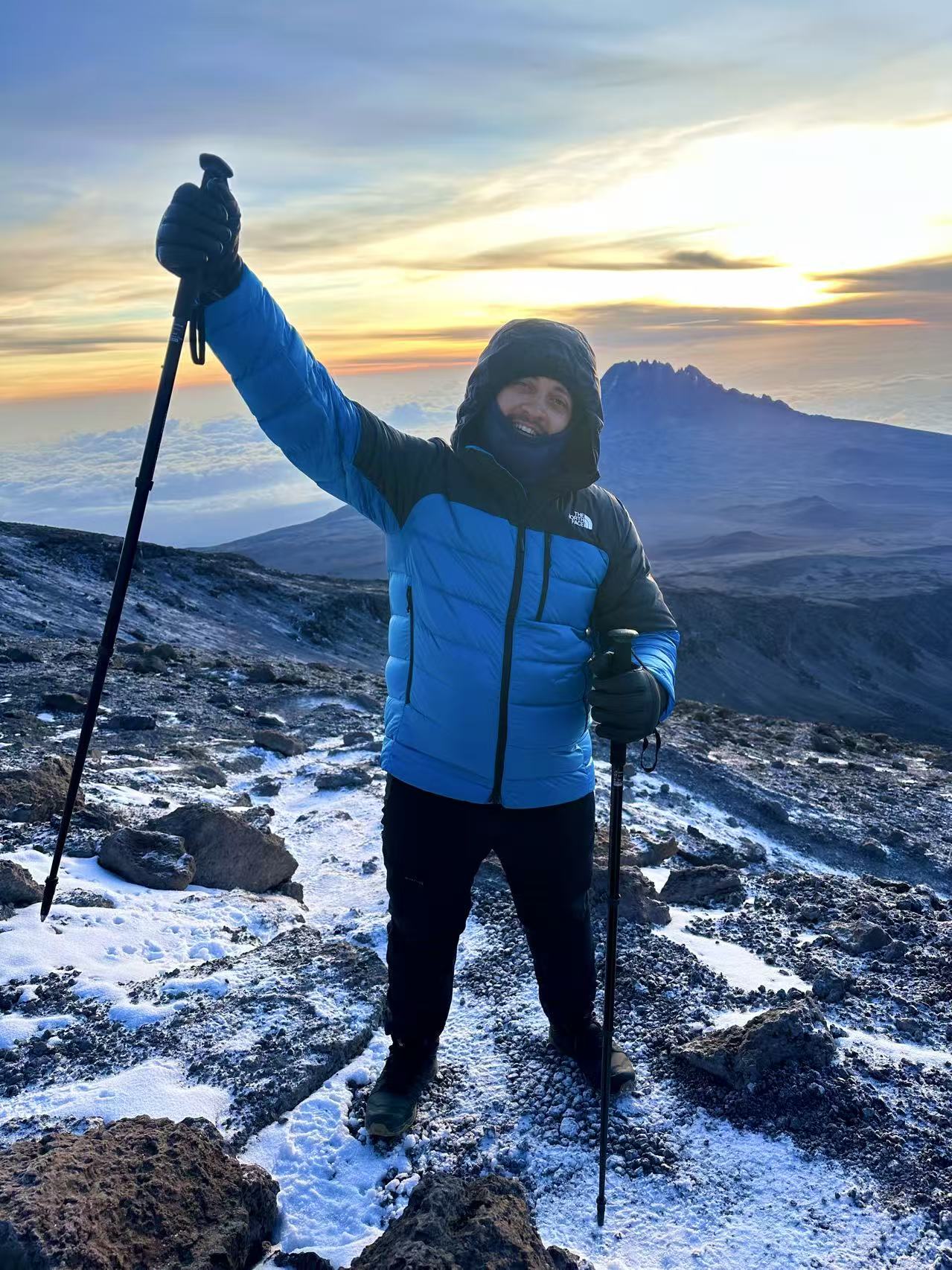
People ask what the summit feels like, expecting euphoria. The truth is stranger. At Stella Point, at 5,756 metres, the emotion arrives before the summit does — because from there you know, for the first time in six days, that you will make it. The last stretch to Uhuru is almost flat, and I remember it as silence: wind, breath, the crunch of frozen scree, and glaciers glowing pink on both sides.
At the sign, there were tears inside the sunglasses, a flag that suddenly weighed nothing, and a thought that has stayed with me since: the distance between "impossible" and "done" is much shorter than it looks from below. You just can't see that until you're standing on it.
Preparing in Hong Kong: Training and Gear
You cannot train for altitude at sea level, but you can train everything else. For three months before the climb I built long weekend hikes through Hong Kong's surprisingly brutal trail network — repeats on steep staircase trails with a loaded pack, ten to fifteen hours of hiking volume a week, plus strength work for the descent, which destroys more knees than the ascent ever does.
On gear, the six-day plan changes nothing: you still need a full four-season kit for summit night. What actually earned its place in my pack:
- A sleeping bag rated to at least −18°C — Barafu nights are brutally cold even in February
- A down summit jacket sized to fit over every other layer, plus proper insulated summit mitts
- Broken-in waterproof boots and trekking poles — the 2,800 m descent punishes knees far more than the climb
- A 3-litre hydration system with an insulated hose, and electrolytes for every single day
- Headlamp with spare batteries kept warm in an inside pocket — yours will die on summit night otherwise
- High-SPF sunscreen and glacier-grade sunglasses; equatorial sun at altitude is merciless
I also spoke with a doctor beforehand about altitude medication and carried it under medical advice; on a compressed itinerary, that conversation is not optional. The final piece of preparation was mental: I wrote down, in advance, exactly what would make me turn around. Deciding that at home, with full oxygen in my brain, is very different from negotiating it with myself at 5,300 metres at three in the morning.
Is Climbing Kilimanjaro in 6 Days Safe?
Here is my honest answer after doing it: six days is the shortest schedule I would tell anyone to even consider, and only with conditions attached. The 60% figure is real, and the four in ten who don't summit aren't weak — they're normal human physiology meeting a schedule that gives it less time than it wants. Altitude sickness on Kilimanjaro can escalate into conditions that are genuinely dangerous, and ascent speed is the single biggest risk factor.
If Kilimanjaro is your dream climb, book 7 or 8 days and enjoy a 90% chance of standing on top. Consider a compressed plan only if you are in strong endurance shape, you have an experienced crew you trust completely, and you agree on hard turn-around rules before you start — then honor them. The mountain rewards patience far more reliably than it rewards bravado. That's not a slogan; it's the data.
Pole, Pole: What the Mountain Taught Me About Business
I went up the mountain as a founder and came down with a better operating manual. Pole, pole — slowly, slowly — sounds like a strange motto for a compressed climb, but it's exactly how the climb worked: a sustainable pace, held with total discipline, for as long as it takes. Not slow. Unhurried. There's a difference, and it's the same difference between companies that survive and companies that sprint into walls.
The other lesson was about risk. We didn't succeed because we ignored the odds — we succeeded because we respected them: trained against them, hired against them, and pre-agreed exactly what failure would trigger. That's how I now think about every serious bet in business. Take the asymmetric shot, but write the turn-around rule before you leave base camp.
Kilimanjaro was summit one of seven. Mount Elbrus — the highest peak in Europe at 5,642 metres — is next, in August 2026. Every expedition will be documented here and in the book series: one climb, one book, until all seven are done.
Kilimanjaro in 6 Days — FAQ
What is the success rate of a 6-day Kilimanjaro climb?
Roughly 60%, compared with about 90% for 8-day itineraries — and around 30% for the 5-day sprints some agencies sell. The difference is acclimatisation time: shorter climbs give your body less opportunity to adapt to altitude, and most people who fail turn back with altitude sickness, not exhaustion.
Which route is best for a 6-day Kilimanjaro itinerary?
I used the Lemosho Route, which preserves the crucial "climb high, sleep low" day at Lava Tower even when compressed, plus recovery nights at Barranco and Karanga. Machame is the other strong 6-day option; Marangu and Umbwe sacrifice more acclimatisation. Whichever route you choose, the crew matters more than the line on the map.
Do you need technical climbing skills for Kilimanjaro?
No. Kilimanjaro is a trekking peak — no ropes, ice axes or crampons on the standard routes. The challenge is altitude, cold and endurance, especially on summit night, which typically starts around midnight and takes 6–8 hours to the crater rim.
When is the best time to climb Kilimanjaro?
The two dry seasons: January–early March and June–October. I climbed Kilimanjaro in 6 days in early February and had clear summit weather with cold, stable nights. The long rains of April–May make trails and camps miserable, and on a compressed itinerary you have no spare day to sit out a storm — so on a fast plan, season choice matters even more than usual.
What comes after Kilimanjaro in the Seven Summits?
For me, Mount Elbrus in the Caucasus — Europe's highest peak — scheduled for August 2026, followed by Denali, Aconcagua, Vinson, Carstensz Pyramid and, finally, Everest. You can follow every expedition on the JR 7 Summits journey page.
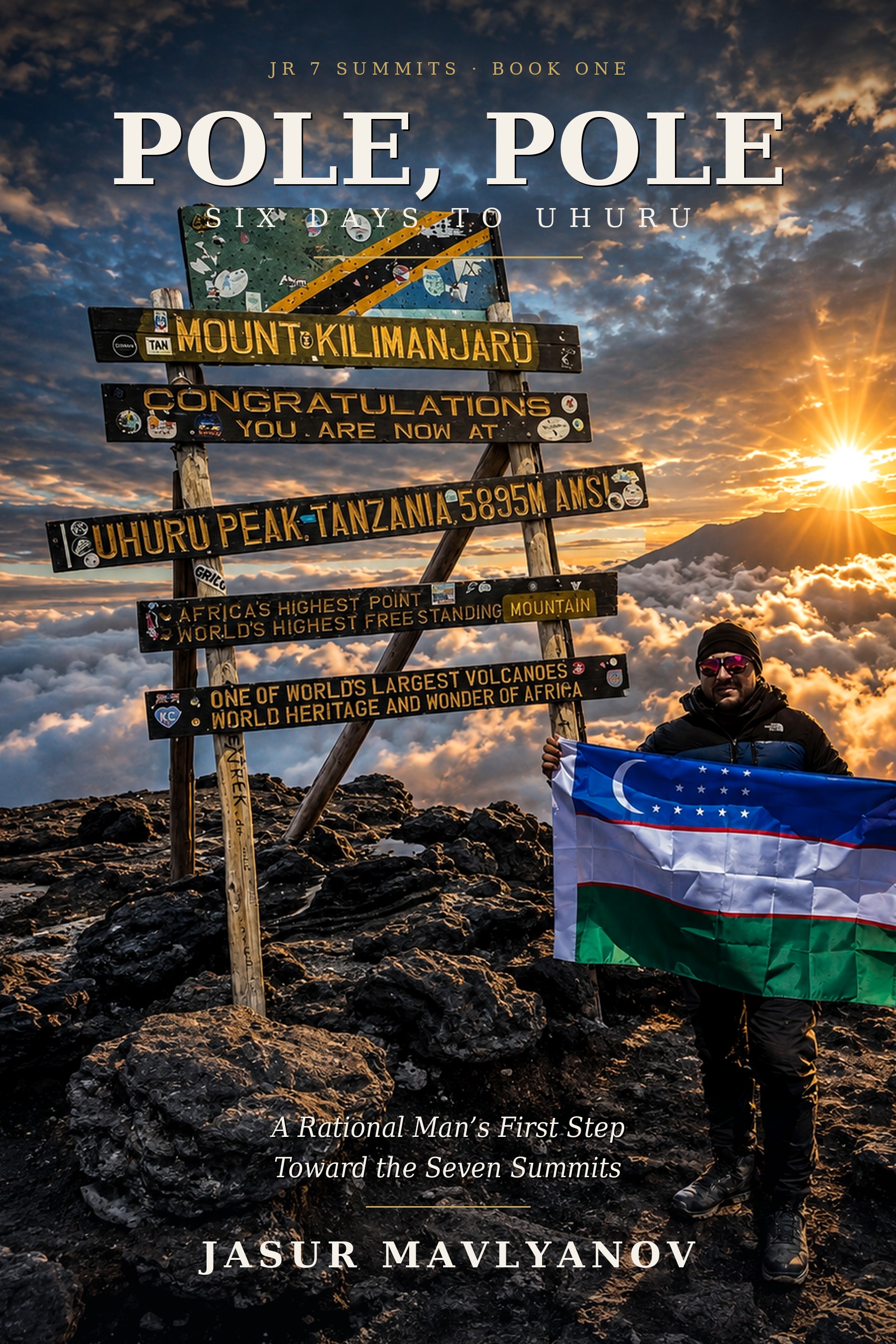
This report is the outline. Pole, Pole: Six Days to Uhuru is the whole climb — day by day, doubt by doubt, from the rainforest gate to the silence of the crater rim. Book One of the JR 7 Summits Series.
Get It on Amazon ↗ About the Series